MSMEs contribute around 30% of GDP, yet many run on one promoter's judgment. SIDBI estimates the sector's addressable credit gap at about ₹30 lakh crore. Cash flow, compliance, succession and hiring pile up fast.
This guide explains what advisors and consultants do, how they differ, the common specialisations, the signs you need help, and how to choose well.
Key Takeaways
- Advisors give ongoing strategic guidance; consultants usually handle a defined problem or project.
- Look for relevant experience, objective analysis and recommendations you can actually implement.
- MSME needs span growth, finance, GST, tax, governance, succession, legal, hiring and subsidies.
- Check scope, credentials, sector experience, confidentiality, deliverables and fees before signing.
What Does a Business Advisor Do?
A business advisor is an experienced professional who helps an owner or leadership team understand problems, weigh options, decide, and keep moving towards strategic goals.
Business diagnosis and strategic planning
Good advisors start by understanding your objectives, business model, finances, people, market and immediate risks. Only then do they recommend action.
From that diagnosis come concrete priorities: decision frameworks, growth plans, risk controls and milestones. Generic advice is a red flag.
Recommendations, implementation, and review
The advisory cycle runs through six steps:
- Collect information on the business, market and constraints
- Analyse the situation against the owner's goals
- Present options with clear trade-offs
- Help the owner choose a direction
- Support implementation with accountability
- Review progress and adjust course
Some advisors give independent guidance only. Others stay involved through meetings, accountability, project coordination and access to specialists.
Areas in which advisors commonly help
Advisors commonly help across areas such as:
- Strategy, operations and market entry
- Working capital, tax and subsidies
- Recruitment, technology and contracts
- Governance, succession and wealth planning
Regulated matters need appropriately qualified professionals.
Take an owner planning a new manufacturing unit. One decision touches:
- Capital and debt structure
- Eligible subsidies
- Entity structure
- Tax treatment
- Hiring a plant head
- Operational readiness
Without coordination, each piece gets handled in isolation and something slips.
The value of an objective outside perspective
An advisor challenges assumptions, spots risks you've stopped seeing, and separates urgent firefighting from long-term leadership work. Decision isolation is real for promoters, since nobody inside the company can easily disagree with the owner.

Over time, better systems, delegation, governance and leadership hiring make the business less dependent on one person.
Business Advisor vs Business Consultant: What's the Difference?
Advisor and consultant overlap in everyday use. Indian professional bodies such as ICAI describe advisory and consulting activities without a strict legal taxonomy. The engagement model is the clearest distinction.
Comparing purpose, time horizon, and involvement
| Factor | Advisor | Consultant |
|---|---|---|
| Engagement | Ongoing, relationship-led | Defined project or problem |
| Output | Decision support, accountability | Diagnosis, plan, or completed project |
| Horizon | Months to years | Weeks to months |
| Involvement | Regular touchpoints | Scoped deliverables |
When a business may need both
An MSME might hire a consultant for a GST process review, market-entry assessment, recruitment assignment or digital rollout, while keeping an advisor for overall direction.
Decide based on:
- The problem and how urgent it is
- Your internal capability and the specialist knowledge required
- Whether you want a one-time fix or continuing counsel
Advisor, consultant, coach, and specialist: avoid confusing the roles
- Coaches focus more on behaviour and accountability.
- Chartered Accountants, Company Secretaries and advocates give regulated or technical advice that requires credentials.
- Strategic advisors should know their limits and bring in specialist counsel when legal, tax or compliance questions arise.
A credible advisor says "this needs a lawyer" without being asked.
Types of Business Advisors and Consultants
Business advisors typically specialise by domain. Most growing Indian MSMEs draw on more than one type over time.
Strategic growth and management advisors
Strategic growth advisors focus on direction-setting decisions that reduce promoter dependence. Typical scope includes:
- Business models and competitive positioning
- Expansion priorities and market entry
- Annual planning and leadership decisions
Financial, tax, and capital advisors
These professionals focus on financial health and how the business is funded. Typical scope includes:
- Budgeting, working capital, debt and equity choices
- Audit readiness, direct tax and GST
- Funding plans beyond conventional cash-credit arrangements
Strategic guidance differs from formal tax or accounting work. Audit under the Income-tax Act 2025, for instance, is a regulated process, so use a Chartered Accountant for it.
Governance, legal, and succession advisors
For owner-run and family firms, these advisors help institutionalise the business. Typical scope includes:
- Formalising governance and clarifying roles
- Structuring holding entities and reviewing contracts
- Protecting intellectual property and managing commercial risk
Succession is a live issue. PwC's 2026 survey found 36% of Indian family businesses have no clear succession plan.
Operations, people, and digital advisors
This group closes execution gaps in process, talent and technology. Typical scope includes:
- Process formalisation and go-to-market planning
- Recruitment of business operators and leadership-team development
- AI and digital adoption
Capability gaps are common here. NITI Aayog's 2025 report found 74% of surveyed MSMEs see AI's potential but lack in-house expertise.

A multidisciplinary model for Indian MSMEs
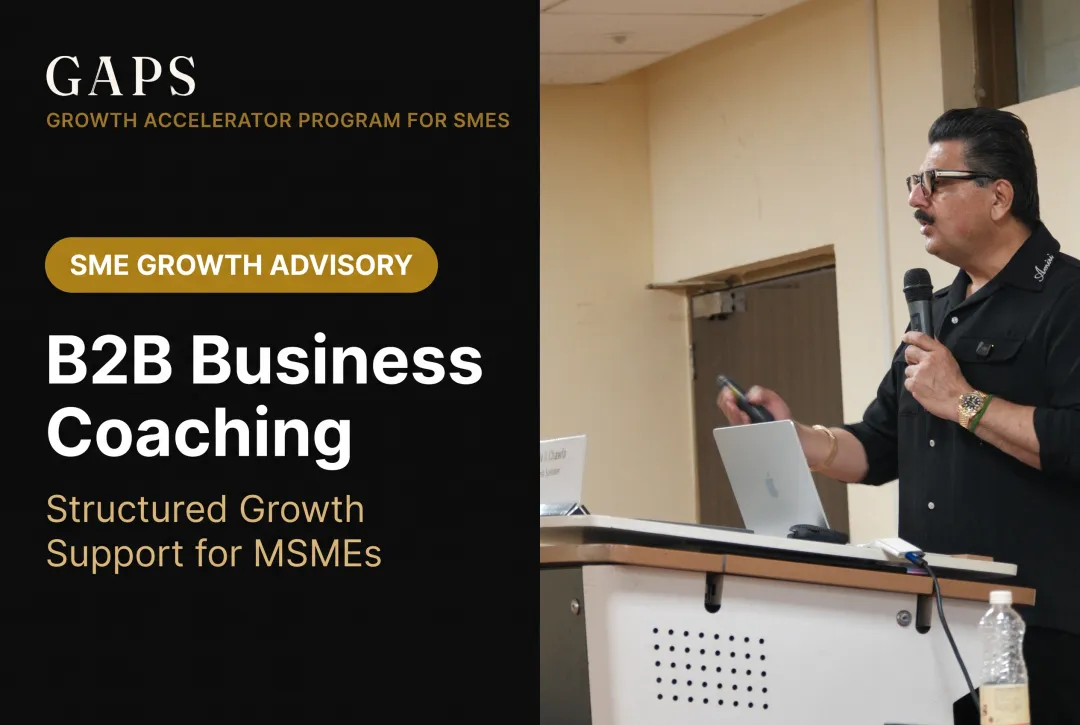
GAPS (Growth Accelerator Program for SMEs) is one example. It is an application-only, one-year advisory and growth programme for Indian MSME owners, led by Rajiv K Chawla, who has mentored more than 800 owners.
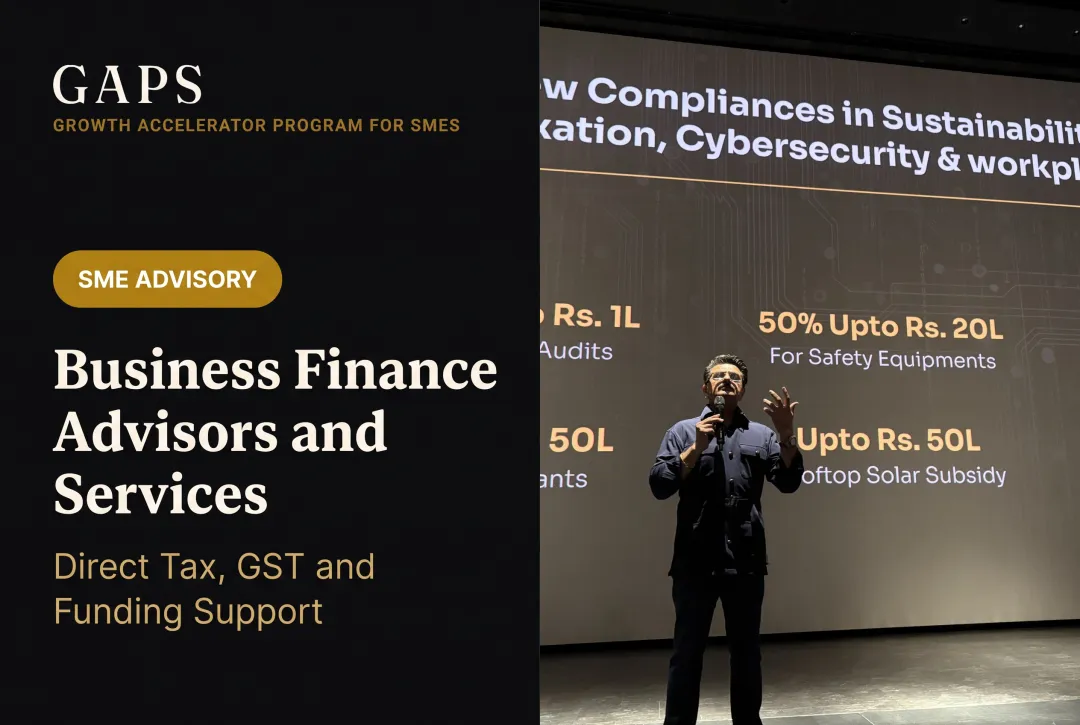
It brings specialist counsel across governance, direct tax, GST, wealth management, subsidies, growth, digital strategy, legal matters and recruitment.
Programme features include:
- Personalised advisory from a nine-member expert panel
- Structured training and peer access
- 24 online sessions and six in-person events
- Nomination for a sponsored 21-day Germany manufacturing immersion (selected members)
These are programme features, not guaranteed business outcomes.
When Should an Indian MSME Hire a Business Advisor or Consultant?
Warning signs that outside support may be useful
- Repeated cash-flow surprises
- Stalled growth
- Unclear decision rights
- Compliance worries
- Founder overload
- Difficulty hiring good managers
- Weak management reporting
- Unresolved family tensions
- Expansion plans with no execution roadmap
Common business situations that require specialised guidance
Advice pays off most at transition points. Typical triggers include a new plant or machinery purchase, entering a new market, a funding decision, and ownership transition.
Other moments that benefit from outside expertise include professionalising a family business, subsidy applications, building a leadership team, and digital transformation.
Subsidy work needs care. Schemes such as PMEGP and CGTMSE have specific eligibility rules, and benefits vary by state and sector. Verify current notifications before relying on any figure.
Choosing proactive support instead of crisis support
You don't need a failure first. An advisor can validate a plan, stress-test assumptions, build governance, sharpen financial visibility, or prepare the business for the next stage.
Keep expectations realistic. An OECD review found mixed results across business-advice programmes. An advisor doesn't replace your judgment or guarantee results. Value depends on the information you share and your willingness to act.
How to Choose the Right Advisor or Consultant
Start with the business problem and required outcome
Write down:
- The decision or problem
- The outcome you want
- Your timeframe
- Internal resources available
- Specialist expertise needed
- Whether you need ongoing guidance or a defined project
Verify expertise, credentials, and relevant experience
Check these before committing:
- Qualifications relevant to the assignment
- Experience with businesses of your size and complexity
- Familiarity with Indian regulation and commerce
- Exposure to your industry
- References and comparable cases
Match credentials to the work. Governance, direct tax, GST, legal, recruitment, manufacturing and digital projects each call for different specialists. ICAI, ICSI, State Bar Councils and the SEBI register for investment advisers all offer public verification.
Confirm the working model before signing
Get clarity on:
- Scope and deliverables
- Meeting frequency
- Access to specialists
- Who is responsible for implementation
- Confidentiality and conflicts of interest
- Fees and reporting
- Termination terms
- How progress is reviewed
Then ask how they diagnose a business, what information they need, how they handle disagreement with an owner, and when they refer work to another expert. The answers show how they work.

Frequently Asked Questions
What does a business advisor do?
A business advisor analyses your needs, offers strategic recommendations, supports decisions and helps you move towards practical goals. The relationship is usually ongoing.
Is business advisory the same as consulting?
The terms overlap. Advisory is often ongoing and relationship-led, while consulting commonly addresses a defined problem, project or specialist deliverable.
What are the key skills needed for an advisor?
Communication, active listening, critical thinking, business knowledge, data literacy, empathy, problem-solving, project management, and the ability to turn complex information into practical action.
When should an MSME hire a business advisor or consultant?
At growth transitions, expansion, succession, rising compliance complexity, founder overload, or cash-flow and operational strain. Seeking help early is better than waiting for a crisis.
How should a business owner choose between an advisor and a consultant?
Choose an advisor for ongoing strategic support and a consultant for a defined project. Either way, assess expertise, credentials, scope, confidentiality, fees and implementation support.